OpenAgentFlow
Architecture
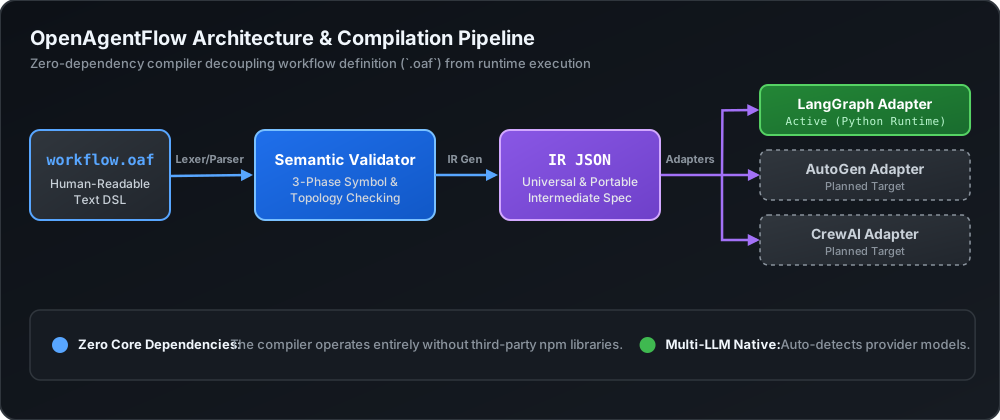
This page explains the design philosophy, compilation pipeline, and module architecture of OpenAgentFlow.
What Is OpenAgentFlow?
OpenAgentFlow (OpenAgentFlow) is a domain-specific language and compiler for defining portable AI agent workflows. Think of it as what OpenAPI is for REST APIs — a neutral, human-readable specification format that separates workflow definition from execution.
The Problem
Modern AI agent frameworks (LangGraph, AutoGen, CrewAI) each have:
- Proprietary Python/Node APIs
- Different agent abstractions
- Framework-specific boilerplate
- Vendor lock-in
The Solution
OpenAgentFlow provides:
- A clean
.oaftext format for defining multi-agent workflows - A zero-dependency compiler that validates and transforms workflows
- Runtime adapters that generate framework-specific code (currently LangGraph)
- Strict validation that catches errors before expensive LLM calls
Design Principles
| Principle | Description |
|---|---|
| Zero Dependencies | The entire compiler runs on pure Node.js — no npm packages required |
| Write Once, Run Anywhere | .oaf files are runtime-independent; adapters generate target-specific code |
| Fail Early | 3-phase semantic validation catches dead ends, missing references, and type errors at compile time |
| Deterministic | The same .oaf input always produces the same IR output |
| Human-Readable | .oaf syntax is designed to be understood at a glance |
Compilation Pipeline
The OpenAgentFlow compiler transforms source code through a series of well-defined stages:
graph LR
    A[".oaf Source"] --> B["Lexer"]
    B --> C["Parser"]
    C --> D["AST"]
    D --> E["Semantic Validator"]
    E --> F["IR Generator"]
    F --> G["IR (JSON)"]
    G --> H["Runtime Adapter"]
    H --> I["Python Code"]
    I --> J["Live Execution"]

    style A fill:#f9f,stroke:#333
    style G fill:#bbf,stroke:#333
    style J fill:#bfb,stroke:#333
Stage Details
| Stage | Module | Input | Output | Description |
|---|---|---|---|---|
| 1. Lexical Analysis | parser/lexer.js |
Source text | Token stream | Tokenizes .oaf source into keywords, strings, identifiers, punctuation |
| 2. Parsing | parser/parser.js |
Tokens | AST | Recursive-descent parser builds an Abstract Syntax Tree |
| 3. Semantic Validation | compiler/validator.js |
AST | Validated AST + Diagnostics | 3-phase validation: symbol resolution, reference checking, graph topology |
| 4. IR Generation | compiler/ir-generator.js |
Validated AST | IR JSON | Transforms AST into runtime-independent Intermediate Representation |
| 5. Code Generation | adapters/langgraph/ |
IR | Python source | Adapter generates executable LangGraph Python code |
| 6. Execution | cli/index.js |
Python code | LLM output | Spawns Python subprocess to execute the workflow |
Pipeline Orchestrator
The Compiler class (compiler/compiler.js) orchestrates stages 1–4. Each stage can also be invoked independently:
import { Compiler } from './compiler/index.js';

const compiler = new Compiler(source, 'example.oaf');

// Full pipeline
const result = compiler.compile();

// Or individual stages
const tokens = compiler.lex();
const ast = compiler.parse(tokens);
const validation = compiler.validate(ast);
const ir = compiler.generateIR(ast);
Module Architecture
graph TD
    CLI["cli/index.js<br/>CLI Entry Point"]

    subgraph Parser["parser/"]
        Lexer["lexer.js<br/>Tokenizer"]
        AST["ast.js<br/>Node Definitions"]
        ParserMod["parser.js<br/>Recursive Descent"]
        ParserIdx["index.js<br/>Public API"]
    end

    subgraph Compiler["compiler/"]
        Validator["validator.js<br/>3-Phase Validation"]
        IRGen["ir-generator.js<br/>AST → IR"]
        CompilerMod["compiler.js<br/>Pipeline Orchestrator"]
        CompilerIdx["index.js<br/>Public API"]
    end

    subgraph Adapters["adapters/"]
        BaseAdapter["base-adapter.js<br/>Shared generate() contract"]
        Engine["template-engine.js<br/> renderer"]
        Adapter["langgraph/index.js<br/>IR → Tokens"]
        Stubs["langgraph/templates/*.py<br/>Python Stubs"]
    end

    CLI --> CompilerMod
    CLI --> Adapter
    CompilerMod --> Lexer
    CompilerMod --> ParserMod
    CompilerMod --> Validator
    CompilerMod --> IRGen
    ParserMod --> AST
    ParserMod --> Lexer
    Adapter --> BaseAdapter
    BaseAdapter --> Engine
    Engine --> Stubs

    style CLI fill:#ffd,stroke:#333
    style CompilerMod fill:#ddf,stroke:#333
    style Adapter fill:#dfd,stroke:#333
Module Responsibilities
| Module | Responsibility |
|---|---|
parser/ |
Lexical analysis, AST node definitions, syntax parsing |
compiler/ |
Semantic validation, IR generation, pipeline orchestration |
adapters/ |
Runtime-specific code generation (currently LangGraph only) |
cli/ |
Command-line interface, argument parsing, subprocess management |
spec/ |
Formal language specifications (not executable code) |
examples/ |
Sample .oaf workflows |
tests/ |
257-test suite across 13 test files |
Three-Phase Semantic Validation
The validator is a key architectural component. It performs three ordered phases on the AST:
graph LR
    P1["Phase 1<br/>Symbol Resolution"] --> P2["Phase 2<br/>Reference Validation"] --> P3["Phase 3<br/>Graph Validation"]

    style P1 fill:#fdd,stroke:#333
    style P2 fill:#ffd,stroke:#333
    style P3 fill:#dfd,stroke:#333
| Phase | What It Checks |
|---|---|
| Phase 1: Symbol Resolution | Duplicate agent names, duplicate state variables, reserved keywords, block cardinality |
| Phase 2: Reference Validation | Flow edge references, input/output variable references, temperature range, provider values, config entries |
| Phase 3: Graph Validation | Start/end edges, reachability from start, path to end, duplicate edges, self-loops, cycle detection |
Each phase only runs if the previous phase found no errors. This prevents cascading error messages from confusing users.
Dual-LLM Provider System
The generated Python code includes a runtime provider selection system:
graph TD
    A["Agent with provider?"] -->|Yes| B["Use specified provider"]
    A -->|No| C["GOOGLE_API_KEY set?"]
    C -->|Yes| D["Use Gemini"]
    C -->|No| E["OPENAI_API_KEY set?"]
    E -->|Yes| F["Use OpenAI"]
    E -->|No| G["Error: No provider"]

    style B fill:#bfb
    style D fill:#bfb
    style F fill:#bfb
    style G fill:#fbb
Key Design Decisions
Why Zero Dependencies?
The compiler runs on pure Node.js to:
- Minimize supply-chain risk
- Ensure portability across environments
- Reduce installation friction (no
npm installneeded)
Why a Separate IR?
The Intermediate Representation decouples parsing from code generation:
- Adapters only need to understand IR, not the AST
- IR is deterministic and JSON-serializable
- Multiple adapters can consume the same IR (LangGraph today, AutoGen/CrewAI planned)
Why Compile to Python?
LangGraph, the primary runtime target, is a Python framework. OpenAgentFlow generates self-contained Python scripts that:
- Include all state definitions, agent functions, and graph construction
- Auto-detect LLM providers at runtime
- Support runtime state injection via
--inputorOAF_INPUT_FILE
Next Steps
- Project Structure — Explore the directory layout
- Workflow Lifecycle — Follow a workflow from authoring to execution
- The
.oafLanguage — Learn the syntax